


Lime and Basil Grilled Tuna Steaks
Are you ready to take your summer grilling to the next level with a dish that’s both delicious and ...
0 item(s)

Free delivery on tests
Understanding your gut microbiome is the first step toward lasting wellness and vibrant energy.
Your digestive tract is home to a complex, busy network of microscopic life that influences your entire body. This system does not just process the food you eat; it acts as a dynamic ecosystem. By learning how this community develops and functions, you can begin to see why its balance is so critical to your everyday well-being.
The term microbiome refers to the trillions of microscopic organisms living inside your digestive system. This massive community includes thousands of different species of bacteria, fungi, viruses, and single-celled organisms. When these microbes are healthy and balanced, they live together in a state of quiet cooperation. Each species plays a distinct role in keeping your bodily systems running smoothly day after day (Hou et al., 2022).
While microbes can be found all over your body, the vast majority of them reside in your large intestine. This specific environment provides the perfect conditions for these organisms to thrive, ferment food residues, and produce beneficial compounds. Think of your large intestine as a highly active metabolic hub where microbes turn dietary fibres into vital nutrients.
Scientists sort gut bacteria into large families called phyla. Two phyla usually make up most of a healthy adult gut: Firmicutes and Bacteroidetes. You can picture phyla as broad branches on a family tree, with thousands of individual species sitting further out on the twigs.
Beyond these large groups, the ecosystem relies on the concept of keystone species. Despite being present in relatively low numbers, these organisms are crucial for maintaining the structural integrity and stability of the entire microbial community. They enable complex metabolic processes and promote the survival of surrounding species, functioning much like the load-bearing stone at the top of an architectural arch.
A well-studied example is Faecalibacterium prausnitzii. It is one of the most researched keystone bacteria in the human gut, valued for producing butyrate and for its anti-inflammatory effects. Another is Akkermansia muciniphila, which lives in the gut lining and is linked with a healthy barrier. When keystone species fall too low, the wider community can become less stable (Martin et al. 2023, Shaheen et al., 2025).
Your microbial journey begins the very moment you are born. Whether you were delivered naturally or via caesarean section, and whether you were breastfed or formula-fed, starts the foundation of your inner ecosystem. As you grow, explore your environment, and introduce solid foods, this community expands and matures. By the time you reach mid-childhood, your unique microbial profile is largely established, though it remains capable of shifting in response to your lifestyle (Zheng et al., 2026).
You and your microbes share a deeply cooperative relationship. You provide them with a warm home and a steady supply of food, and in return, they perform essential jobs you cannot do alone. They break down complex carbohydrates, synthesise vital vitamins, and help keep harmful pathogens from taking over. It is a vital daily partnership that keeps your whole system working (Adak & Khan, 2019).
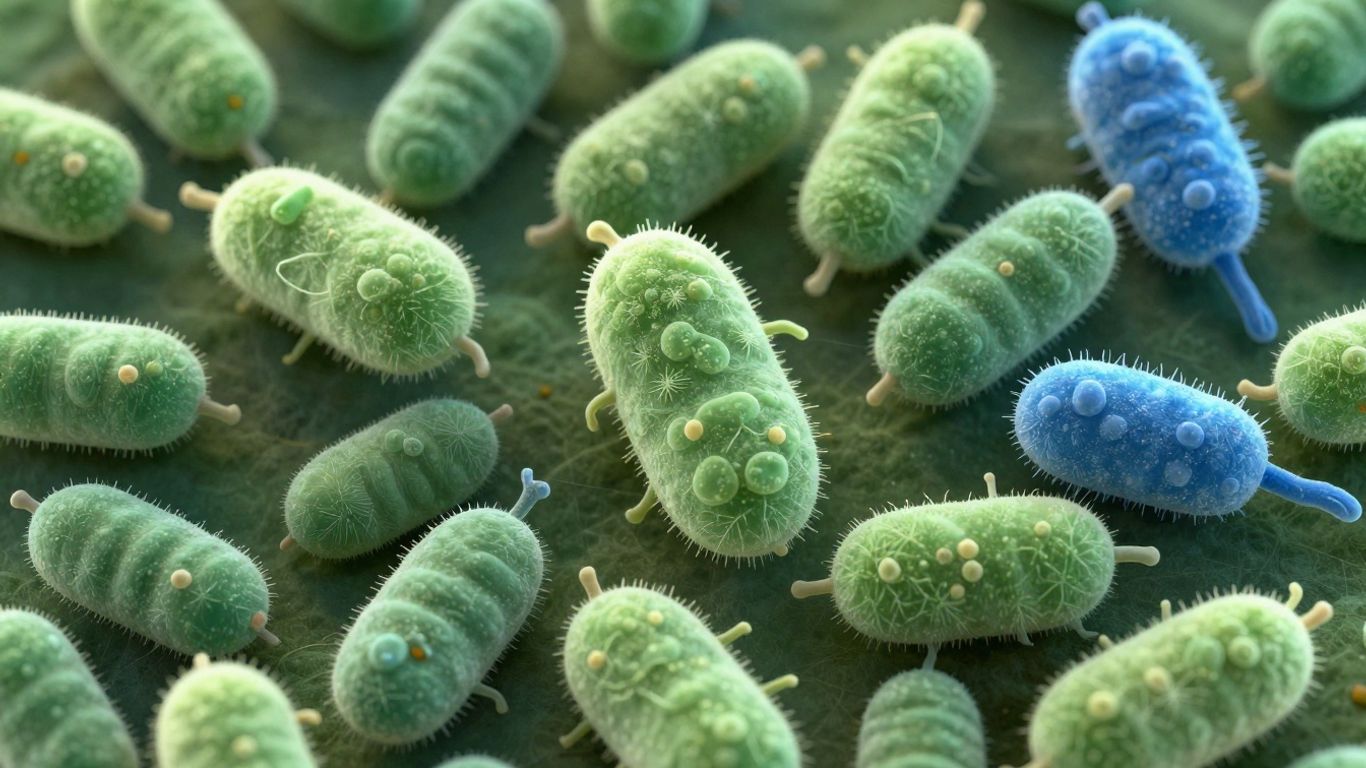
Every day, the microscopic companions in your digestive tract actively shape how your physical body functions. From the way you break down a simple meal to how your body fights off common seasonal bugs, these microbes are always at work. Their balance determines whether your system runs efficiently or struggles to keep up.
Your body cannot fully digest everything you eat without help from your inner microbes. These organisms possess specialised enzymes that break down complex dietary fibres into short-chain fatty acids (Hays et al., 2024). This process nourishes your gut lining and improves the absorption of essential minerals like calcium and magnesium.
An astonishing seventy percent of your immune system is located right within your gut wall. Your microbes are in constant communication with these immune cells, training them to recognise the difference between friendly visitors and dangerous invaders. To help illustrate how these microbial functions translate to overall bodily balance, consider the following biological dependencies:
Without this constant, quiet education from a diverse microbial population, your immune defences can become hypersensitive or sluggish. This fine-tuned equilibrium is what keeps your natural defences ready to respond without causing unnecessary internal inflammation (Belkaid & Hand, 2014, Hou et al., 2022).
Your microbes also play a substantial role in your metabolic health and how you process energy. Different types of bacteria are more efficient at harvesting calories from your food than others, which can influence how your body stores fat. A varied and well-balanced community supports a healthy metabolism and helps regulate blood sugar levels naturally (Li et al., 2026).
Your inner ecosystem is not static; it is constantly being reshaped by external inputs. Everything from the constituents of your diet to your environment influences the trajectory of your microbial population.
Diet is the most influential tool for modulating your internal microbial landscape. Microbes thrive on a wide variety of plant fibres, polyphenols, and complex carbohydrates. Consistently consuming a diverse array of whole plants provides the prebiotic fuel necessary to sustain a robust microbial population. Conversely, diets high in refined inputs can alter the dominant microbial strains over time (Zhang et al., 2022).
Environmental exposures and daily habits such as exercise (Varghese et al., 2024) and stress (Chang et al., 2024) continually interact with and impact your microbiome. While your internal ecosystem is resilient, it is also sensitive to physiological stressors and external chemical factors. Maintaining a lifestyle that supports regular rhythms and provides ample nutrients for your microbes is essential for long-term health.
The gut microbiome is a complex, living ecosystem that serves as a cornerstone of human biology. From the foundational roles of phyla like Firmicutes and Bacteroidetes to the structural contributions of keystone species, this internal world is essential for digestion, immune coordination, and metabolic health. By respecting the needs of this community through informed and consistent daily choices, you support the enduring function and stability of your own internal ecosystem.
Your microbiota is the community of tiny living things in your gut, like bacteria, fungi, and viruses. Your microbiome means something a little bigger. It includes those living things, all of their genes, and the things they make and do inside you.
What are phyla and keystone species?
Phyla are large family groups that scientists use to sort bacteria. Most of the bacteria in your gut come from just a few of these big groups. Keystone species are special microbes that matter far more than their small numbers suggest. Helpful ones like Akkermansia muciniphila help keep your whole gut community healthy and steady.
Where does the gut microbiome live?
Microbes live all the way along your gut, but most of them settle in your large intestine. This part of your gut is slower and has very little oxygen, which these microbes love. They live in the open space where food passes through, and in the soft, protective layer of mucus that lines your gut wall.
What is a “healthy” or “balanced” gut microbiome?
There isn’t one perfect gut microbiome that everyone should aim for. But healthy guts do tend to share a few things. They usually hold a wide variety of different microbes, they have plenty of the helpful ones that make good things for your body, and they stay fairly steady over time. Think of it like a thriving garden with lots of different plants, rather than a single crop.
What is dysbiosis?
Dysbiosis is the word scientists use when the gut community falls out of balance. This might mean there are too few helpful microbes, too many unhelpful ones, or simply less variety than there should be. When this happens, the gut can struggle to do its normal jobs well, and this is linked to a range of health problems.
Does everyone have a different microbiome?
Yes, and this is one of the most fascinating things about it. Your gut microbiome is shaped by so many things, like how you were born, what you eat, where you live, and even the people and pets around you. Because of this, no two people have exactly the same mix of microbes, not even identical twins. Your microbiome is truly your own.
1. Gilbert, J. A., et al. (2018). Microbiome-wide association studies link dynamic microbial consortia to disease. Nature, 535(7610), 94-103.
2. Belkaid, Y., & Hand, T. W. (2014). Role of the microbiota in immunity and inflammation. Cell, 157(1), 121-141.
3. Cryan, J. F., & Dinan, T. G. (2012). Mind-altering microorganisms: the impact of the gut microbiota on brain and behaviour. Nature Reviews Neuroscience, 13(10), 701-712.
4. Li et al., (2026) Gut microbiome and metabolic health: mechanisms and precision interventions, Gut Microbes. 21;18(1):2644677
5. Zhang et al., (2022) Influence of Foods and Nutrition on the Gut Microbiome and Implications for Intestinal Health, Int J Mol Sci. 2022 Aug 24;23(17):9588
6. Shaheen et al., (2025) Akkermansia muciniphila: A key player in gut microbiota-based disease modulation, Microbiol Res:301:128317
7. Martin et al., (2023) Faecalibacterium: a bacterial genus with promising human health applications, FEMS Microbiol Rev, 5;47(4):fuad039
8. Zheng et al., (2026) Temporal variations of the gut microbiome in human health, The Lancet Microbe
9. Adak & Khan (2019) An insight into gut microbiota and its functionalities, Cell Mol Life Sci;76(3):473-493
10. Varghese et al., (2024) Physical Exercise and the Gut Microbiome: A Bidirectional Relationship Influencing Health and Performance, Nutrients, 28;16(21):3663
11. Chang et al., (2024) Stress-sensitive neural circuits change the gut microbiome via duodenal glands, Cell, 19;187(19):5393-5412.e30
12. Hays et al., (2024) The interplay between gut microbiota, short-chain fatty acids, and implications for host health and disease, Gut Microbes, ;16(1):2393270.
13. Hou et al., (2022) Microbiota in health and diseases, Signal Transduction and Targeted Therapy volume 7, Article number: 135